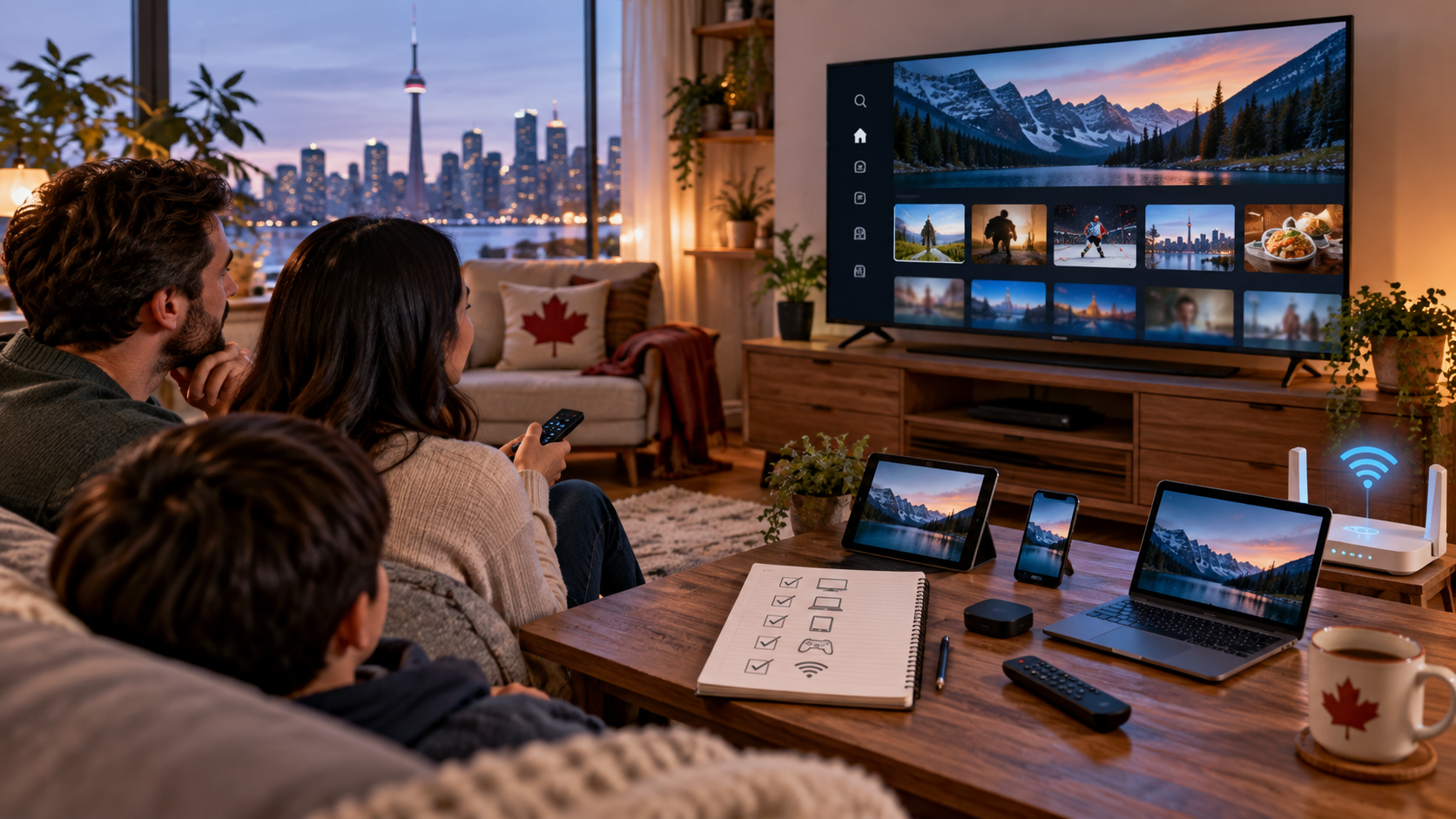
If you are deciding whether an IPTV live service will work in your home, test the factors that affect everyday viewing before paying for more than a short trial. In 2026, the biggest mistakes usually involve device compatibility, home network limitations, poorly planned trials, and service stability during the hours your household actually watches—not channel counts.
Start with the decision that matters most: will your setup support it?
Many people start with the plan page. A better first question is: can your TV, streaming box, internet connection, and household habits handle this service without friction? This is more useful than comparing long feature lists. A service may look excellent on paper but still feel awkward in your living room.
For Houzz readers, it is a little like choosing a sofa based only on the dimensions listed on a product page. What matters is how it fits the room, how often you use it, and whether the surrounding space supports it. With internet television, that “room” includes your home network and devices.
Common mistakes that make a good service look bad
Before testing anything, understand the mistakes that can create a falsely negative impression. These are among the most common:
- Testing on the wrong device. A service may work well on one box but feel clumsy on another.
- Assuming speed alone prevents buffering. Even a fast internet plan can be unstable when Wi-Fi is weak or the household network is congested.
- Testing only during a quiet hour. A service that works well in the morning may behave differently during busy evening hours.
- Overlooking the app and remote controls. If the guide, search, pause, or channel-switching functions are slow, daily viewing can become frustrating.
- Mistaking setup problems for poor service quality. Faulty wiring, old firmware, or a weak Wi-Fi signal can cause problems that are not the provider’s fault.
The goal is not perfection. It is to determine whether the service fits your household well enough for comfortable, everyday use.
Device support should be verified before you compare channel lineups
Device compatibility is easy to overlook and difficult to fix later. A service may support smart TVs, streaming sticks, set-top boxes, or Android-based devices, but that does not mean the experience will be equally smooth on every platform.
Check whether the provider gives clear instructions for the devices you already own. To understand the setup questions that usually matter, the Iptvrove guide to Computing is a useful starting point for general device and home-setup considerations.
What to confirm on your actual hardware
- Does the app install properly on your television or streaming device?
- Can you log in without repeated code resets or unexpected prompts?
- Is the interface easy to read from where you normally sit?
- Do the remote controls work as expected?
- Can you switch between live channels without lengthy delays?
Requiring a particular type of hardware is not automatically a problem. What matters is whether the provider explains that requirement clearly before you subscribe. Vague compatibility information is a warning sign because it can cause avoidable setup confusion later.
Internet speed is useful, but it is not the whole reliability story
Many buyers ask, “How fast does my internet need to be?” It is a reasonable question, but speed is only part of the answer. For live television streaming, the more practical concern is whether your connection remains stable during the hours you normally watch.
A household may have an internet plan that looks strong on paper and still experience poor performance. This can happen when several devices are active at once, the Wi-Fi signal is weak near the TV, or an older router struggles with modern traffic. A good speed-test result does not guarantee smooth evening viewing.
Test the connection the way your home uses it
Before subscribing for long enough to feel committed, complete these checks:
- Run tests in the evening. This is when many households place the greatest demand on their internet connection.
- Test near the TV. A strong signal in the hallway does not necessarily mean the family room has equally good coverage.
- Use the device you intend to keep. Results from a phone may not reflect the experience on a television box.
- Look for consistency. One smooth stream is encouraging, but repeated use provides a more accurate picture.
A service that performs well during a trial while other household devices are active offers stronger evidence than any isolated speed reading. If it struggles whenever someone else streams, games, or joins a video call, your network capacity may be the issue rather than the service itself.
Use the trial to gather evidence, not impressions
A trial period is most valuable when you approach it with a test plan. The purpose is not to be impressed for a few minutes. It is to determine whether the service works on a typical weeknight under normal household conditions.
When a provider offers a trial, use it deliberately. Keep notes about your experience instead of relying on memory afterward. If you are considering multiple options, written notes make it easier to compare services fairly.
A simple trial checklist
- Check how quickly the service starts after you open the app.
- Try live channels at several times of day.
- Switch channels repeatedly to see whether delays are occasional or consistent.
- Test pause, resume, and any available guide functions.
- Check whether the experience remains consistent across more than one device.
- Record any buffering, audio synchronization issues, or login problems.
Compare your first impression with your third or fourth viewing session. A service that feels impressive for ten minutes may become tiring when used the way a family actually watches television—while cooking, multitasking, or moving between rooms.
“A useful trial should show you how a service behaves on an ordinary night, not just at its best moment.”
Reliability shows up in small details before it shows up in big outages
When people discuss reliability, they often ask whether a service ever goes down. That matters, but it is not the only measure. Everyday reliability also covers performance under light pressure, including quick channel changes, steady audio, responsive menus, and consistent playback after pausing or returning to the app.
A service can feel unreliable without failing completely if it hesitates too often. A few extra seconds may not seem significant on their own, but repeated delays can make the experience feel less natural than traditional television.
Evidence worth paying attention to
- Startup time: how long does it take for live content to appear?
- Channel switching: are delays occasional or constant?
- Picture consistency: does the quality remain steady during longer viewing sessions?
- Household tolerance: does the service continue working when other devices are active?
- Support responsiveness: if something goes wrong during setup, is help easy to reach and understand?
Support quality matters because no home setup is perfect. Unclear instructions or a difficult support process can turn minor issues into lengthy interruptions. This is especially relevant for Canadian households setting up multiple devices in different rooms and across varying internet plans.
Canadian households should also think about home layout and evening usage
In many homes, the bottleneck is not the service but the connection between the router and the television. A basement TV, second-floor bedroom, or room behind thick walls may receive a weaker signal than the area where the internet equipment is located. Judge the service in the room where you will actually use it.
This is also why single-device tests can be misleading. A stream that performs well beside the router may not work the same way across the house. To learn more about device-specific options, setup practices, and compatibility concerns, you can also IPTV live for a broader overview of practical considerations.
For some households, a wired connection to the TV area provides the greatest stability. For others, better Wi-Fi coverage or less network congestion may solve the problem. The right approach depends on the home, not only the subscription.
A plain-language setup check before you buy
Use this practical checklist to reduce surprises before committing:
- Confirm that the service supports your primary device.
- Test it on the TV or streaming box you intend to keep.
- Check evening performance instead of testing only during the day.
- Look for buffering, login friction, and slow menu responses.
- Make sure the trial covers more than one viewing session.
- Evaluate the service in the room where you will actually watch.
If you are comparing devices or exploring alternatives, it may also help to learn more about iptv 2025 in the context of hardware compatibility and local setup decisions. The central lesson remains the same: match the service to your home, not the other way around.
The safest choice is the one you can verify in your own home
The best internet television option is rarely the one with the longest feature list. It is the service that proves during a short trial that it works with your devices, rooms, internet setup, and viewing habits. Focusing on evidence rather than promises makes unpleasant surprises after subscribing less likely.
For Canadian consumers in 2026, the key decision points are device support, home network stability, trial quality, and everyday reliability. A service that passes these tests is more likely to work well in practice, rather than simply looking appealing on a sales page.