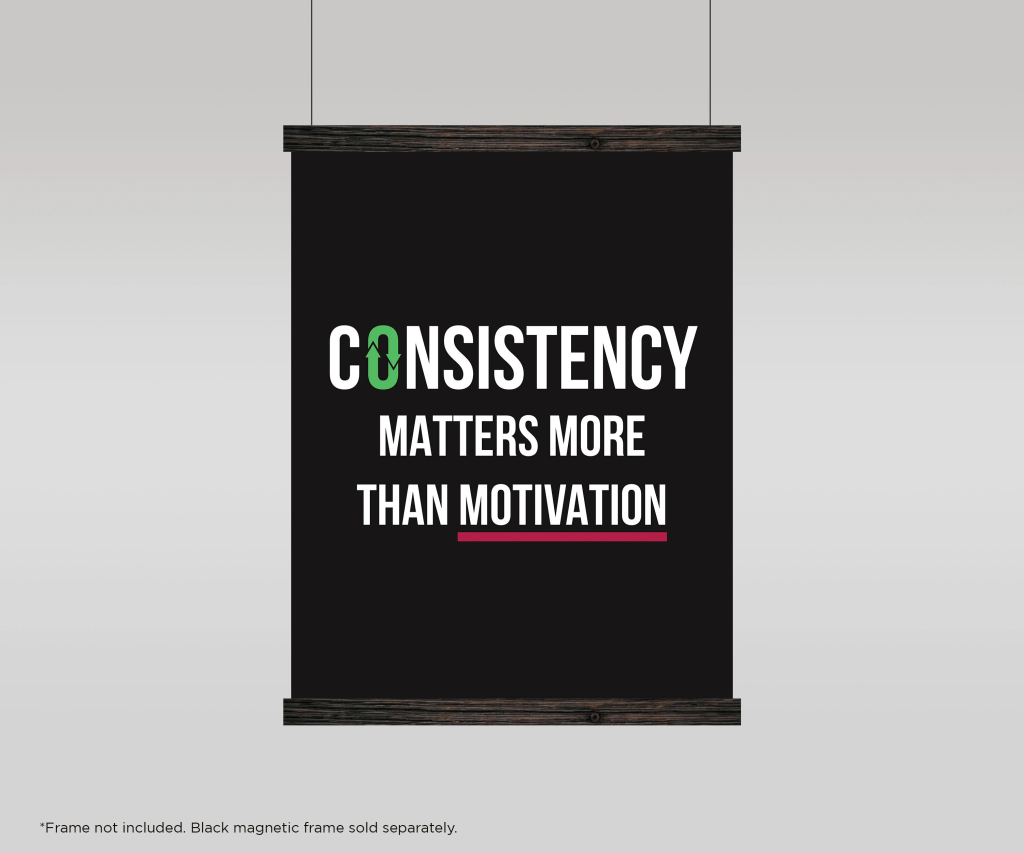
You know that feeling when you wake up one morning full of energy, ready to conquer the world? You tell yourself, this is it. You’re finally going to get in shape, start that side hustle, or write that book you’ve been talking about for years.
And for the first few days, it’s great. You’re on fire.
Then — a week later — it’s gone. The fire dies out. You’re tired, distracted, or just “not feeling it.”
That’s motivation. It’s powerful, but temporary. It comes and goes like the weather. And that’s exactly why consistency beats motivation every single time.
Motivation Is a Spark, Not a Fuel Source
Motivation feels amazing — it’s what gets us started. It’s the rush that makes us believe change is possible. But here’s the truth: motivation is unpredictable. It fades when life gets busy, when things get hard, or when you stop seeing results right away.
That’s where consistency steps in.
Consistency isn’t glamorous. It’s waking up early even when you didn’t sleep well. It’s showing up for your goals when no one’s watching. It’s doing the small, sometimes boring stuff — over and over — until it becomes part of who you are.
Think of it like brushing your teeth. You don’t do it because you’re wildly motivated to. You do it because it’s part of your routine. You know if you skip it long enough, things get messy.
Consistency makes progress inevitable. Motivation just makes it exciting in the beginning.
Why We Rely Too Much on Motivation
We’ve been conditioned to chase motivation.
Social media, self-help books, those “rise and grind” videos — they all feed this idea that if you’re not pumped to do something, you’re doing it wrong.
But the truth?
The people who actually reach their goals aren’t hyped up 24/7. They’re the ones who keep showing up, even when it’s boring, uncomfortable, or hard.
Motivation depends on your emotional state. Consistency doesn’t care how you feel.
You can’t control how motivated you’ll feel tomorrow morning, but you can control whether you stick to your plan.
The Science Behind Consistency
Psychologists have studied this for years. Motivation comes from a mix of dopamine (the reward chemical) and emotional energy. But the brain adapts. When you do something new, it releases more dopamine. Over time, the excitement fades, and your brain wants something new again — that’s why it’s so hard to stick with habits.
Consistency, on the other hand, rewires your brain through habit formation.
When you repeat an action regularly, your brain starts shifting that behavior from your prefrontal cortex (the thinking part) to your basal ganglia (the habit center).
That means it takes less mental effort to keep doing it. It becomes automatic.
So, in short: motivation lights the match, but consistency keeps the fire burning.
Small Steps Add Up Faster Than You Think
Here’s the tricky part — people overestimate what they can do in a week and underestimate what they can do in a year.
Consistency compounds, just like money in a savings account. Tiny, regular actions build massive results over time.
- You don’t need to write a whole chapter a day. Just write for 15 minutes.
- You don’t have to run 10 miles. Start with one.
- You don’t need to meditate for an hour. Try five minutes.
When you show up daily, even in small doses, you start to trust yourself more. That trust builds momentum — and that’s way more powerful than fleeting motivation.
Consistency Builds Discipline (and Discipline Creates Freedom)
Most people think discipline means being strict or miserable. But it’s the opposite.
Discipline is freedom. It’s the ability to rely on yourself — to know that even when things get messy, you’ll keep going.
Consistency builds that muscle. Every time you choose to act instead of wait for motivation, you’re strengthening your self-control. Over time, you stop needing motivation altogether.
Think of athletes, writers, entrepreneurs — none of them feel inspired every single day. They succeed because they’ve built systems and habits that don’t rely on how they feel in the moment.
How to Stay Consistent When Motivation Dies
Let’s be honest — staying consistent is hard. There will be days when you slip, when life hits, when you just don’t want to do it. That’s normal. The key is to not let one missed day turn into a lost week.
Here’s what actually helps:
- Start ridiculously small. Build the habit first, scale later.
- Track your progress. Even tiny wins keep your brain hooked.
- Have a “bare minimum” rule. Do something, even if it’s just 5 minutes.
- Make it visible. Keep reminders where you’ll see them — sticky notes, phone wallpapers, whatever works.
- Be patient. Growth takes time. Motivation fades fast; habits take root slowly.
Final Thoughts
Motivation might get you started, but consistency keeps you going when the excitement fades.
It’s the quiet, often invisible effort that builds real change — one day, one step, one choice at a time.
If motivation is the spark, consistency is the engine.
And if you can learn to keep that engine running — even slowly, even imperfectly — you’ll go farther than anyone waiting for the perfect wave of motivation to hit.So, don’t chase motivation. Build consistency.
That’s where the real magic happens.
Leave a Reply